par Reese Saxment
The Powers of Jouissance
Mad Love, the subject of Breton’s 1937 masterpiece of that name, adored and revered by Surrealism, and the foundational impulse of the new surrealist politics proselytised by Breton from the 1940s, has been a driving force in our hearts, minds and poetry since ancient times. We can think of Helen and Paris, Guinevere and Lancelot, Tristan and Iseult, but it is Shakespeare (recognised by Breton in the 1924 ‘Manifesto’ as a precursor of Surrealism) who brings it into sharper focus, as the inexorable tragic destiny in Romeo and Juliet (c. 1594), the dynamism of joyous celebration in Midsummer Night’s Dream (c. 1595), and the power of transformation in Antony and Cleopatra (c. 1606), as the bereaved Cleopatra declares her ‘immortal longings’ – ‘I am fire and air; my other elements I give to baser life…’. In all of these plays female characters provide the emotional and erotic heart – Juliet, Hermia, Cleopatra, – and it is Cleopatra’s magnificent speech that opens the portal to The Tempest (c. 1611) and other later plays of alchemy and redemption.
But what of the fuel that fires Mad Love? Here we can do worse than focus on jouissance – ecstasy – a recurring term of varied usage in late 20th century French theory. For Roland Barthes jouissance contrasts with mere plaisir as we engage with ‘open’/ writerly texts as opposed to the ‘closed’/ readerly / realist ones that Breton so detested; for Jacques Lacan (an intimate of surrealist circles in the 1930s) jouissance is the excessive psychic energy that overspills all channelling or binding by conscious and social control.
More importantly, the French Feminists of Psych et Po in the 1970s, explored jouissance as the erotic principle of liberation, most powerful in the female psyche, where it provides a surging dynamic of subversion and revolt against the oppressive phallic regime of the Symbolic Order.
For Luce Irigaray, ‘Woman has sex organs just about everywhere. She experiences pleasure almost everywhere…’, postulating the entwined lubricated lips of the vagina as a dynamic symbol of female sexuality (an image echoing Man Ray’s 1934 painting À l’heure de l’observatoire, les amoureux where Lee Miller’s lips float in the sky above the Paris Observatoire).
Hélène Cixous championed l’écriture féminine, wild, musical and spontaneous, generating sexts as an alternative and challenge to mainstream, rule-bound texts of littérature, where all signifiers march in disciplined rhythm to dictate meaning to the reader. For Cixous, the receptive openness and embracing of otherness of l’écriture feminine expresses the plurality and fluidity of the feminine self, arising from a female subject position (which male writers like Joyce and Genet could also occupy), enabled by women’s more direct access to the oceanic jouissance of their bodies. In ‘The Laugh of the Medusa’, a luminous prose-poem that is both an illustration of and a call to arms for l’écriture féminine, Cixous extols the power of female desire, insisting instead that woman’s ‘libido is cosmic, just as her unconscious is world-wide’, and that her own ‘desires have invented new desires, my body knows unheard-of songs’. Urging women to overcome shyness and embarrassment over their secret worlds of fantasy, she promises that ‘beauty will no longer be forbidden’, and exhorts women to write, to ‘write through their bodies, (to) invent the impregnable language that will wreck partitions, classes, and rhetorics, regulations and codes…’. Female bodies must not be silenced, for ‘Censor the body and you censor breath and speech at the same time’, and, acknowledging the complicity of many women in silencing themselves or other women, she adopts an uncompromising tone – ‘We must kill the false woman who is preventing the live one from breathing’. For Cixous, ‘Almost everything is yet to be written by women about femininity: about their sexuality’, and she called on her readers to ‘Write your self. Your body must be heard. Only then will the immense resources of the unconscious spring forth’.
For Psych et Po, the erotic and the mystical are deeply entwined: in Irigaray’s words, ‘mysticism is the domain of the feminine: here the unconscious speaks’, while Cixous speaks of divinity, dream and the mystical, and the need to write the impossible. Jouissance also takes us close to the inferno: Cixous urges women to ‘go into the forest’, to explore the ‘Dark Continent’; Julia Kristeva focuses on the Abject (with which femininity has an intricate and intimate relationship) – that which is excluded by the clean and tidy morality of society – but which provides possibilities of radical change, while for Catherine Clément jouissance is both the energy of rapture and syncope in mysticism, love, creativity and joy, but also of seizure, possession and hysteria – by no means exclusively an arena of pleasure, but also the violent, the macabre, the bloody and the agonising.
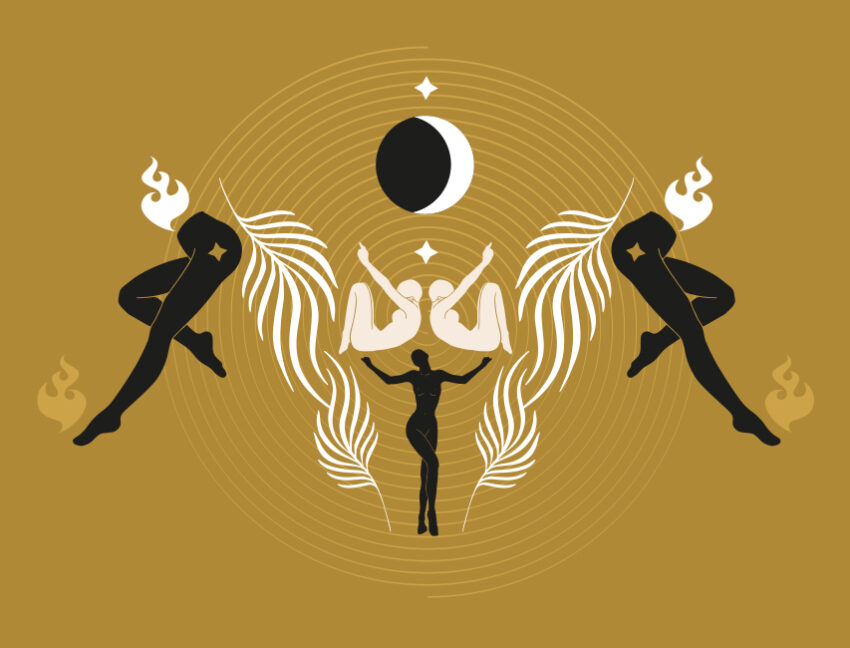
Irigaray, Cixous, Kristeva and Clément are not surrealists, and are rarely discussed in surrealist contexts, but it is not hard to see them in a dialogue with discourses of Amour Fou, liberation and revolt, mystical/ erotic female muses, and the gloriously dangerous fires of wild unconscious desire that we find across the Surrealist spectrum from Breton to Bataille.
Reese Saxment
Illustration du haut, ©Érato – Artnographiste