par Reese Saxment*
In the Second Manifesto of Surrealism (1930) Andre Breton drew attention to the ‘remarkable analogy… between the surrealist efforts and those of the alchemists’ and called (very loudly) for ‘THE PROFOUND, THE VERITABLE OCCULTATION OF SURREALISM’. The long and fruitful love affair between Surrealism and the occult is often dated to this moment, but the relationship went back further. By his own admission Breton’s encounter with the works of Symbolist painter Gustav Moreau in 1913 when he was sixteen had made a huge impression on him, fusing in his mind mystery, magic, beauty, sensuality, opulence, debauchery and the femme fatale, which he said ‘forever influenced my idea of love’. Soon after he bought his first pieces of non-western art, beginning a life-long interest in collecting ‘magical’ artefacts from the Americas, Africa and Oceania (where Picasso had recently been finding inspiration).
Meanwhile, in Vienna in 1914, psychoanalyst Herbert Silberer’s book Problems of Mysticism and its Symbols was published, in which alchemy was explored as a metaphor for psychological development. Silberer’s book wasn’t exactly a smash hit. Even in psychoanalytic circles it didn’t make much headway – Freud finding it faintly interesting at best, and Jung dismissing it as ‘off the beaten track and rather silly’ [although in 1944, as he rebranded himself as benign mystical guru after his unfortunate dalliance with the Nazis, he co-opted Silberer’s ideas as his own in his Psychology and Alchemy]. But Silberer’s work did have its admirers, including young German painter Max Ernst, who, on his arrival in Paris in 1922 fell in with Breton and his circle of young poets, who were in the process of breaking away from Dada to establish their new ‘Surrealism’. Breton and his group welcomed Ernst warmly – for his art, his knowledge of Silberer and alchemy, and his clearer and more comprehensive grasp of Freud, all of which were adopted by Surrealism.
Attunement to the occult sensibility was evident in the first Manifesto of Surrealism (1924) when Breton hailed the Marvellous as the essence of beauty, and within a year one commentator was observing ‘The idea of any sort of Surrealist revolution […] aims to create a new form of mysticism’. For Breton however, the occult was always an essentially erotic world – Alchemy, Psychoanalysis and Marxism cross-fertilising in an orgasmic vision of human transformation and redemption, combining the Chemical Wedding, psychological catharsis and political revolution into one liberating eruption. As he put it in the last line of Nadja (1928), ‘beauty will be CONVULSIVE or it will not be’.
The mystical and the occult fuelled the work of women surrealist artists from the 1930s, including Leonor Fini, Remedios Varo, Frida Kahlo, Leonora Carrington and Ithell Colquhoun, during which time Breton [in L’Amour fou (1937) and elsewhere] was raising the flag of Eros against the forces of reaction and repression. In Marseilles in the winter of 1940-41, surrealist refugees from the outbreak of war, including Breton and Ernst, designed their own Tarot pack, and Breton called out for a ‘new myth’ centred on the erotic, prophesying ‘A new spirit will be born from the present war… As always when socially human life is almost worthless, I think we must learn to read with and look through the eyes of Eros – Eros, who in time to come will have the task of re-establishing that equilibrium briefly broken for the benefit of death’.
Steadfastly opposed to fascism and Nazism (as were the Surrealists in general, Dalí excepted), as the Second World War neared its end Breton was unenthusiastic about the brave new world that the soon-to-be victorious capitalism and communism promised. In 1944, inspired by a new love, Elisa Claro, and news of the liberation of Paris, Breton composed his next (and perhaps last) great work, Arcanum 17, the title referencing the Star, the 17th card of the Major Arcana of the Tarot deck, symbolising hope and resurrection. Drawing on the ideas of early 19th century utopian socialist Charles Fourier, Breton looked for the salvation of humanity through a rediscovery of ancient wisdom and myth, in particular the redemptive power of the feminine principle, all of which had been buried for centuries under patriarchal ‘civilisation’. The personification of this feminine principle in Breton’s mythology was Mélusine, a folkloric faerie mermaid – half woman, half fish/serpent – enchanted femme-enfant, figure of youth, clairvoyance and love, whose power offers spiritual rescue to mortal man. Breton’s wish was that one day, ‘may we be ruled by the idea of the salvation of the earth by woman, of the transcendent vocation of women…’, exhorting artists to ‘make visible everything that is part of the feminine’. Already an alchemical figure combining different elements, Mélusine represents the feminine principle uniting in conjunctio with the masculine in the Chemical Wedding, from which the Elixir or Philosopher’s Stone is born, and provides inspiration for a new reverence for woman and the liberation of her sexuality.
On his return to Paris in 1946, Breton relaunched the Surrealist movement with old friends (like Toyen and Benjamin Péret) and new (notably Jean Schuster and later Joyce Mansour), with his revived interest in the mystical and occult playing a central role. Here he was opposed by Revolutionary Surrealists who charged him with retreating from political engagement into obscurantism and esotericism, but a more insightful view is that he was engaging in a different kind of politics. This ‘Politics of Eros’ is described by Alyce Mahon as the best way ‘to understanding post-war surrealism, its subversive intent and vital role in the culture of that period’ – a radical politics which ‘embraced the power of the Id’, articulating the ‘sexual, erotic body and its uncanny power’, presenting the female body as an object of desire, a route to the marvellous, and redemptive in its role as ‘the path and space for revolt’ against the brutalism that passes for ‘civilisation’.
The occult and subversive power of Eros, particularly pronounced in the work of the women artists, guided Breton for the rest of his life, shaping major publications and exhibitions during his lifetime and since, and inspiring much of the best work in the current renaissance of Surrealism.
Additional sources: Alyce Mahon Surrealism and the Politics of Eros Thames and Hudson 2005 pp. 15-16/ René Passeron, Surrealism Éditions Terrail/Edigroup 2005, p. 64 / Mark Polizzotti Revolution in Mind Black Widow Press 2009 p. 18/ M.E. Warlick: Max Ernst and Alchemy University of Texas Press 2001, p. 229 note 62.
*Reese Saxment auteur du livre : Story of O: Eros, Paris & Surrealism
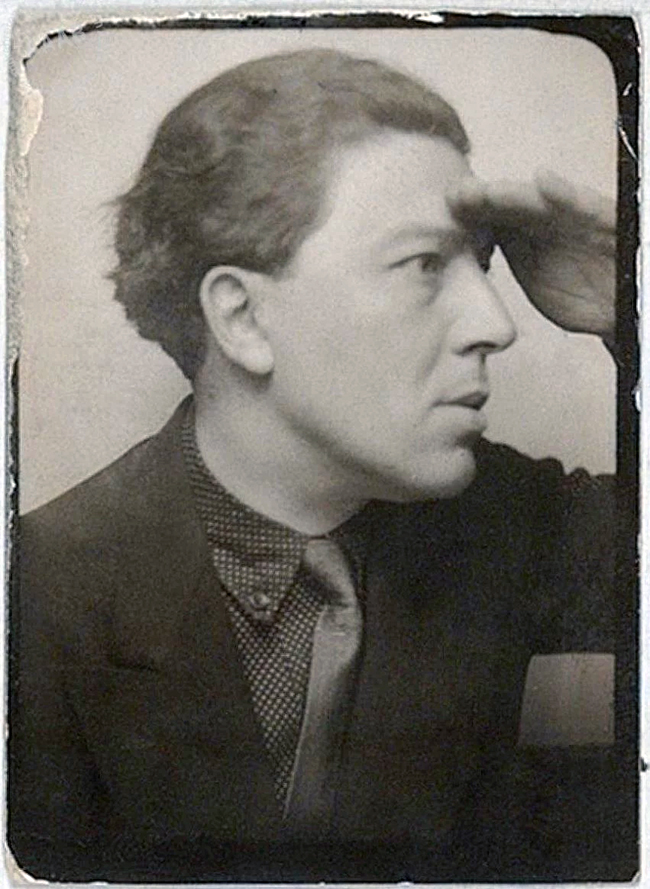
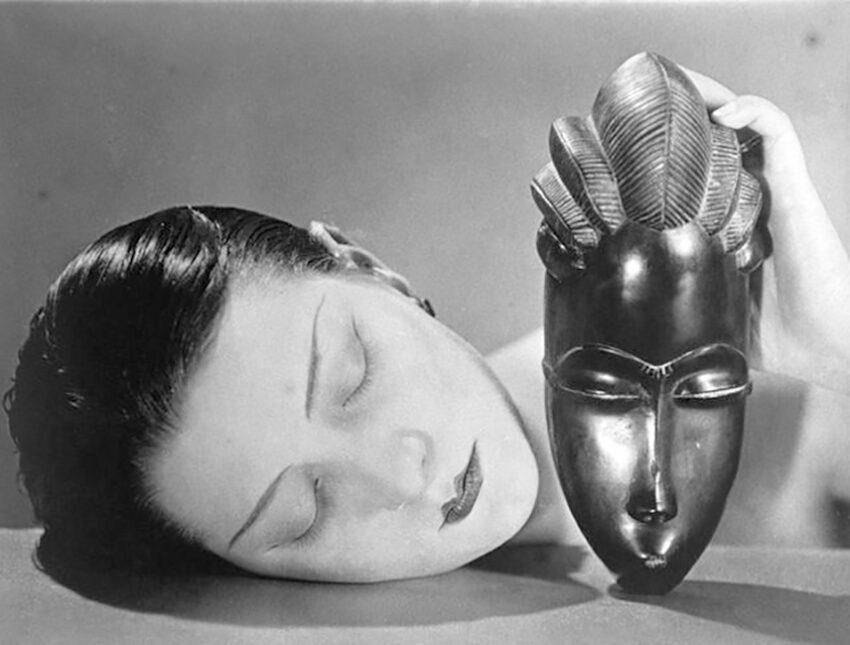
Photo du haut ©Man Ray « Noire et Blanche, 1926 » – Photo ci-dessous, portrait André Breton, 1929